
Home
- Review
Index - Ratings
- Content
Icons - Links
X The Unknown
|
|
X The Unknown |
|
|
||
Title:
X The Unknown
Year Of Release: 1956 Running Time: 80 minutes DVD Released By: Anchor Bay Entertainment Directed By: Leslie Norman Writing Credits: Jimmy Sangster Starring: Dean Jagger, Edward Chapman, Leo McKern Taglines: 1. It Kills But Cannot Be Killed! 2: It rises from 2000 miles beneath the earth to melt everything in it’s path. 3: Machine Gun Bullets! Dynamite! Flame Throwers! Nothing Can Stop It! Alternate Titles: None Found Review Date: 3.20.05 (updated 1.1.10) |
|
Shadow's Title: "The Murderous Mudbath" Buy
This Film From Amazon Blu-ray DVD |
| Characters
|
 |
Dr.
Adam Royston – An
American physicist working in Scotland. The film never explains why he
is working overseas. He is the “hero” of the film in that
he is the first who realizes what they are dealing with and also comes
up with a way to destroy it. |
 |
Inspector
McGill – He works for the internal security division
of the United Kingdom Atomic Energy Commission, which makes for some small
print on his business cards. He comes to investigate the initial theft
from Royston’s lab and the burning of Willie Harding that seems
linked to it. |
 |
Peter
Elliot – He is an administrator at a facility run
by the Atomic Energy Establishment, but he wants to be a scientist in
the worst way. Why, I have no idea as not one single scientist in the
film was shown with a hot chick at his side. In fact, there were no hot
chicks whatsoever in this film. |
 |
John
Elliot – This old grump is Peter’s father
and the director of the facility where the younger Elliot and Royston
work. He likes to yell at Royston for letting Peter help with the scientific
work rather than remain a pencil pusher. He also is the requisite doubting
Thomas in the film. |
 |
Major
Cartwright – The local military man. It was he and
his men who were present when the fissure first opened, and it was he
and his men who stupidly tried to kill X and cover the
opening up. He bears the stereotypical military outlook – to solve
any situation, just shoot something. |
 |
Corporal
“Spider” Webb – A soldier under Major
Cartwright’s command. He and his buddy Haggis offset the seriousness
with some humor. Sadly, it falls somewhat flat, as they do nothing but
moan about how hungry they are. Both end up as little puddles of sticky
goo. |
 |
Haggis
– A soldier under Major Cartwright’s command. He and his buddy
Spider offset the seriousness with some humor. Sadly, it falls somewhat
flat, as they do nothing but moan about how hungry they are. Both end
up as little puddles of sticky goo. Uh…why does that sound familiar? |
 |
Ian
Osborne – A young boy who dares his friend Willie
to sneak to an old local tower at night and see if some drunk known as
Old Tom sleeps there. He is more fortunate than his pal and only gets
a glimpse of X, rather than an up close and personal greeting. |
 |
Willie
Harding – Willie has a chance encounter with X on
his way to spy on Old Tom and winds up getting a lethal radiation exposure,
dying of burns the following day. Still, it could have been worse...he
could have caught a glimpse of Old Tom sleeping one off in his underwear.
|
 |
X
the Unknown – The title critter. It is actually
an intelligence from the center of the earth made up mostly of pure energy.
It animates a big pile of mud and rolls around the countryside absorbing
radioactive materials, growing larger with each meal…kinda like
Star Jones. |
| The
Plot Hold your cursor over an image for
a pop-up caption
|
The Seargent hiding the container is instructed to place it somewhere where Lansing won’t take all day to find, and we get the impression that Lansing is the odd man out among the men and something of a geek (in those days before geeks were called geeks). As Lansing stumbles around the big muddy field trying to locate it, two other soldiers sitting atop a nearby hill discuss the proceedings. Though the film won’t reveal their names for some time, they go by Haggis and Spider. Spider is bitching because their delay in leaving means they will be last at the cookhouse. Lansing continues to wander around and Bannerman briefs his men again on the use of the Geiger counters, reminding them that in the future they will no doubt be dealing with harmful materials and should only mark the place where such stuff is located and leave it for others to deal with. Everyone is ready to leave but Lansing is still wandering that big muddy field like Richard the third looking to trade his kingdom for a horse. Spider doesn’t want to be out there any longer and tries to give Lansing some hand signals, pointing him in the right direction. Finally, it’s apparent that Lansing is taking waaay too long and Bannerman jogs down the hill and out into the field to see what the problem is. It appears that Lansing is detecting a very strong reading. In fact, what he is registering is far stronger than the small container should be emitting. Long about now Major Cartwright shows up in a jeep and trudges out to talk with the Bannerman, asking him why he hasn’t got his men moving. Bannerman explains about the odd readings. Bannerman has Lansing mark the spot where the anomalous readings were taken while he leads the Major off to locate the container with the harmless amount of radioactive crap. While this is going on, Haggis and Spider engage in a little more whining and bitching to each other. Meanwhile, Lansing notices that the small puddle at his feet is beginning to boil. He tries to call to Bannerman to let him know, but Bannerman is busy with the Major and brushes him off. Soon the earth begins to split at Lansing’s feet. He calls out again and now everyone can hear a low rumbling sound. The order is given for the men to evacuate the area and everyone gets their asses into gear…except Lansing. Now we see why everyone groaned when he was given his turn. The man is a complete idiot. Soon enough the ground begins to shake and everyone is high tailing it out of the field and over a nearby hill...everyone except Lansing. He just stands there looking at the ground and then falls over as the shaking increases in intensity. The ground splits wide open and a wall of flame shoots up and blocks the idiot’s escape as the others look on in amazement. Most people would look on in horror I suppose, but when someone is that freaking stupid, all you can do is stand dumbfounded at their sheer idiocy. Now the scene changes and we see a sign on a fence forbidding anyone to pass. It was put in place by the Atomic Energy Establishment and as the camera pans away from it we see a large facility partially hidden behind some trees. Within, scientists are walking about amongst all the high tech (for the 50’s) gear and engaged in whatever things scientists do. My bet is that they trade Star Trek jokes in between rounds of Doom and marathons of The X-Files. A female voice over a loudspeaker pages a Dr. Adam Royston to the director’s office. One guy is in the middle of some project involving a container of cobalt. This is Peter Elliot and his old man is the director of the facility. The woman’s voice breaks in again with her call for Dr. Royston and a second scientist remarks to the first that his father must be out for Royston’s head. All too soon his father, John Elliot, shows up and grills his son on the whereabouts of this Royston fellow. Peter offers up some excuse and his father chews him out for not doing his own work before walking off to track down Royston. A brief exchange between Peter and another scientist reveals that Royston is engaged in some private project in his lab. Now we cut to said lab where Dr. Royston has turned on a radio and jacked the volume to near deafening levels. He checks a few more instruments nearby then takes cover in a shielded room nearby. Manipulating some controls, he opens a container in the other chamber and using a magnet, lifts out a small metal jar very similar to that being used by the military out in that muddy field. As soon as the jar clears the container, which no doubt must be made of lead, the music on the radio is filled with static. Royston then passes the jar back and forth between two objects that for all the world look like miniature radar dishes. He consults some notes, but nothing seems to have changed in the other chamber.
We now are in Director Elliot’s office where he is reminding Royston that he is in charge and will decide what projects the Doctor will or will not pursue. He asks him to not waste his son Peter’s time. It seems Peter’s job is in administration and he only has scientific interests, rather than credentials. Royston has been nurturing those interests much to the chagrin of Elliot the elder. Then the Director mentions that the army has phoned in and is asking for an authority on radiation to help them out. Royston wants somebody else to go, as he is busy with his current project, but the Director makes him go. Now we are back out in that muddy field where the army was playing with their Geiger counters. Royston is examining a patch of ground with one of said gizmos but notes to Major Cartwright that there is no radioactivity in the area any longer. Royston asks if there has been a mistake made, but the Major assures him that once he sees the men, he’ll no that no errors have been made. They walk over to where the men are gathered, just as an ambulance arrives to pick up Lansing. The Major informs Royston that Lansing was nearest the explosion and only seemed a bit shaken up at first, but then some severe burns began to appear over his body. Another man who was closest to Lansing when all hell literally broke loose is also sporting some nasty looking burns that will no doubt adversely affect the poor sod’s sex life in years to come. The outline of the man’s rifle – slung over his shoulder at the time of the incident, can clearly be seen on his bare flesh. The injured men are quickly ushered away so they can get medical attention, while Royston enlists Cartwright’s aid in making plans for further equipment to be brought in. Haggis and Spider gossip a bit about Lansing’s sad state and the likelihood that they will not be getting back before breakfast now. Night has now fallen and the equipment that Royston wanted is being assembled at the site, complete with floodlights to illuminate the muddy field. A group of men are grilling Major Cartwright on the events from earlier in the day. I don’t know whether these guys are reporters or just locals, but they are a mighty curious and somewhat paranoid lot, jumping to conclusions at the drop of a hat. While dispensing information to these clowns, Cartwright reveals that that poor bastard Lansing has died from his burns. A subordinate comes to tell him that Royston wants to speak with him and the Major makes his escape from the group of irate men, warning them as he leaves that if they don’t behave, he will have them removed from the area. As Cartwright passes Haggis and Spider, the camera lingers on them long enough to hear them bitch and moan some more about the lack of food and how hungry they are getting. So far, we are sixteen minutes into the film and every single time these guys have been shown, they do nothing but whine and cry. It’s like being at a Democrat rally the day George W. Bush was re-elected. Royston and his men, including scientist wannabe Peter, are examining the fissure in the earth when Major Cartwright approaches to speak with the good doctor. Royston explains to him that there is nothing more he can do this night and suggests posting a couple men (gee I wonder what two clowns might pull that duty…) over night to ensure that no fool inadvertently steps into the fissure. The Major thinks it might be better to just rope the area off and post some warning signs so that no one has to spend the night out there (I can almost here Haggis and Spider sighing in relief now). He asks Royston how deep the crack is and Royston replies by dropping a rock into the hole and saying, “no we haven’t,” when no sound is forthcoming after several seconds. It seems the operative range of the equipment Royston brought is limited and cannot tell them what they need to know. Royston bids the Major good night and heads off. In the car on the way home, Peter talks to Royston about the fissure. The Doctor is puzzled by it, as the forces that usually cause the earth to split open do not burn people to death with radiation. He advises Peter to be cautious in his hypotheses and not to start conjuring up nameless horrors creeping around in the night. That last bit seems to provoke a reaction from the driver, who looks like he may have added more than just skid marks to his undergarments.
Now we see a nurse marching down a hospital corridor, carrying a bottle. She enters a room where Royston and a local medical doctor are examining young Willie, who is laid up in bed and looking like hell. The boy has first degree radiation burns, which is the reason the local medic has called for Royston. They talk with the boy’s parents, who are naturally quite upset, though they have no idea what has happened to their son. Royston tells them that he was burned and is trying to figure out what exactly burned him. Willie’s mother informs Royston that her son had the burns on his body that morning when she went to wake him. Royston asks where he might have been the night before but they don’t know – though they do know that Willie was out with Ian. If anyone knows what happened to Willie, Ian would be the one. It must be Sunday because now we see people exiting a church. Young Ian is with two other boys, look for all the world like he could care less that his buddy Willie is stretched out in the hospital developing the Freddy Krueger look. As they are about to leave Ian is called over to speak to Royston, who asks him where he and Willie went the night before. Ian is reluctant to say anything as the two boys had sworn an oath, but Royston reminds him that Willie is very sick and would want Ian to do whatever he could to help him. So Ian reveals that they went to the tower in the marshes and that he had dared Willie to go to the tower. As he is speaking, the scene slowly fades out… And into a car traveling down an isolated road. It comes to a stop and Royston emerges with a Geiger counter. He walks off into the woods and makes his way toward the tower that was Willie’s original destination from the previous night. He finds the door slightly ajar and proceeds to let himself inside. He makes his way up to a second level where he finds a rather Spartan living area, complete with homemade still. Passed out a nearby cot is “old Tom” himself. Royston shakes him awake and the first thing the old geezer does, after getting the obligatory wet cough out of the way, is to sip from his homemade brew. He offers some to Royston, who politely and sensibly refuses. Old Tom reaches for a cup on a nearby shelf and is at this moment that Royston sees a small jar among the assorted stuff occupying the small space. It is nearly identical to the small jar of radioactive crap that he was playing with the day before – you know, the one he was passing between miniature radar dishes via remote control? This jar is also strikingly similar to the one the army was playing with out in that muddy field. If I didn’t know better I’d think the movie was about possessed metal jars roaming the Scottish countryside, but at this point I’m gonna guess that the same jar was utilized by the producers on all three occasions. Talk about a versatile jar! I wonder if it won an award? Anyway, Royston recognizes the jar as having come from his workshop and asks old Tom where he got it. The old guy drunkenly mutters something unintelligible and reaches for it, but knowing how radioactive it is Royston uses his cane to knock it away from Tom’s grasp. He hauls out his Geiger counter but there is no discernable reading. Now we see Royston back in his lab, which is in a sorry state. The place is a mess, with the glass window that separated the two main chambers now in numerous pieces, and a visible scorching on a worktable. Peter comes in, having been called by Royston and has a look around. The lead box, which originally held the small jar, has been melted to near slag and is coated with an odd residue. Royston says it was also covering the jar when he found it at the tower. It seems all the damage was caused by someone who was solely interested in stealing that small jar. What is even more odd is that the material contained within the jar would normally take twenty-eight years before the radioactivity died away, but Royston has Peter use a Geiger counter to take a reading and show to him that it is now quite inert. The day before the material exhibited dangerous levels of radioactivity, but now…nada. The energy from that material has been drained away, and given that the windows were barred and the door locked when Royston returned, then whoever broke in must be most unusual. Over in Director Elliot’s office, Inspector McGill has arrived to investigate the entire stolen jar affair. He represents the internal security division of the United Kingdom Atomic Energy Commission and Director Elliot thinks it is a waste of time, but McGill reminds him that when any type of crime is committed in relationship to the facility, the big wigs have to come snooping around and not just le the local police handle it. Elliot dismisses Royston’s claims about the material in the jar losing it’s radioactivity overnight, but McGill is adamant in wanting to speak with the American. McGill goes looking for Royston and finally tracks him down in the facility’s commissary. McGill asks him if he knows how young Willie Harding was burned and Royston says it is possible he handled the stolen container. McGill admits that he has already spoken to old Tom in the tower and discovered that Willie was never anywhere near that container, so something else is responsible for burning him. McGill wants Royston’s help in discovering exactly what that may be. Over at the hospital, Doctor Kelly is covering Willie’s head with a sheet. It appears the youth has died. The doctor ushers the boy’s grieving parents out of the room and into his office. Royston and McGill arrive and Kelly gives them the bad news. Poor Willie never even regained consciousness. His father emerges long enough to blame Royston and his radioactive toys for his son’s death before leaving with his wife. Doctor Kelly follows them while Royston and McGill head down the hall in the opposite direction.
Some time later the hospital director leads Royston and McGill into the Radiation Room. He points to a vault and tells them that this is where they store the radium. The vault door has a large hole melted through it and the radium is gone. Royston notes that it was obviously the target. Other things they note are the fact that the heat required to melt through the vault door must be hotter than anything they know, the theft must have taken place in just a mere few minutes and that same odd residue is covering everything in the room. McGill wants to talk to the nurse and find out what she can tell them, but Doctor Kelly arrives and informs him that the nurse is so traumatized that she won’t even be able to tell them her own name. The hospital director asks Royston how anyone could get in with so many people out in the hall. Royston points to a metal grill cemented into the wall and says that this is where the intruder entered. The others seem taken aback and one reminds him that whatever it was that burned through the vault and took the radium was too big to fit through a grill. Royston comments that ten thousand gallons of oil can take up a large amount of space yet still fit through the grill. Then he realizes that this is the same method the intruder used to break into his lab – it came in under the door. Obviously, Royston reasons, the intruder can take up any shape it needs to in order to achieve its goals. Now this is the point where most rational people would look at him, point their index finger towards their temples, make a circular motion and go “coo-coo…coo-coo,” but McGill does not do this. He simply asks where “it” may be now. Royston theorizes that it is “somewhere out on the ridges” and is glad that Major Cartwright did not take his advice and station a couple of men out there. “But he did,” McGill intones ominously. Uh oh! And I’ll give you one guess as to who the two unlucky bastards are that drew that assignment! That is right – Haggis and Spider! They are out at the fissure that has now been roped off and engaged in their favorite pastime – bitching, whining and moaning. Haggis thinks he hears something and when he looks out over the field, he thinks he sees a glow. He tells Spider that he better go have a look and the other man takes a few steps then stops, wondering why he must go. The two argue briefly as to whom will go take a look and as they do, the glow vanishes. Finally Haggis decides he will look and tromps off across the field. Just as he disappears from sight, he calls out to Spider and then lets loose with a scream. Spider calls to him a few times and when no answer is forthcoming, sets off cautiously to see what has happened to him. He makes his way out into the field and stumbles across Haggis’ rifle…but no sign of his friend. He picks it up but from his movements we can see that the weapon is covered with that same odd residue that has been cropping up all over as of late. Then we hear the tell tale sound of the Geiger counter-like noise and Spider whips around to see something behind him. He unslings his gun and we get another POV view of whatever “it” is as it closes in on him. He fires off a few rounds, an odd illumination lighting up the night, and then whatever “it” may be, it is upon him and he screams and falls to the ground. A car pulls up to the roped-off fissure and three men – Major Cartwright, Royston and McGill – get out. The Major calls for his men but there is no answer. They look around a bit and the Major finds the burned beret that belongs to one of the missing men. Alas, poor Spider/Haggis...I knew them well. Back at the Atomic Energy plant Royston convenes a meeting of the minds. He thinks he has an idea as to what they are dealing with. To make a long story short, he theorizes that the center of the earth is home to intelligences that may predate man, life forms that may have once existed on the earth’s surface and who now find their world being compressed out of existence. In order to survive, they may be turning to the surface in order to find a way to live. Being life forms made up of almost pure energy; they must seek out other forms of energy on which to subsist. Other forms of energy like radiation – radiation that did not exist in ages past, but with the onset of the nuclear age, is now in abundance upon the earth’s surface. Royston admits it is just a theory and has no idea how big such a creature may be, but McGill thinks it needs to be found and killed. Royston points out that killing it may be difficult – it is almost pure energy after all. Conventional weapons would be useless. Director Elliot pipes in now and condemns the entire theory. It seems he is the obligatory Doubting Thomas. When it is clear that he cannot sway the others, he stomps out. McGill suggests trying to get a look at the creature and Royston says that they will need to go back to the fissure. When McGill points out that they have been there more than once and seen nothing, Royston tells him that someone will have to go down into the fissure. GULP.
Once he gets to the top he confirms Royston’s theory and tells them of the body he found below. He is a bit shaken up and can’t accurately describe what he saw, so Royston takes him away by car so he can calm down. At this point Major Cartwright informs them that his orders are to kill whatever is down there and concrete over the fissure. He plans on getting started immediately and walks off to get things underway. The army now engages in some truly futile efforts – though to be somewhat fair, they might not have known this. They shoot flames at the opening, throw explosives into the fissure and detonate them, then wrap things up by pouring concrete over the opening. Forget what I said. These guys are idiots. Whatever is down there lives by consuming the energy from radioactive materials. Stuff so radioactive that it will kill people within minutes. A lifeform that generated enough heat to melt through that lead vault…yet these bozos think that some fire and an explosion will kill it?! Something that has moved through miles and miles of solid rock and now they think a few inches of concrete will deter it? Now, I have the utmost respect for people in the armed services, but in this case…look out people, the inmates are loose and running the asylum! In his wrecked lab, Royston is cleaning up and going over some things when McGill arrives and gives him the lowdown on what the army did out at the fissure. Royston is as critical of their methods as I just was, making nearly all the same arguments and referring to “it” as an unknown quantity…an X. He shows McGill a container that has a small sample of radioactive mud in it and asks the inspector how does one go about killing mud? McGill mentions that he has been recalled to London but asks Royston if X will get loose again. Royston admits that he does think it will and when McGill asks if there is anything that can stop it, he mentions the project he has been working on for a some time now – a method of disintegrating atomic structure obviating the resulting explosion. By passing radioactive crap between his two scanners – those miniature radar things – he hopes he can someday find the right frequency to render it useless. The repercussions of such a discovery on a global scale are obvious – nuclear missiles could be deactivated in flight before landing, thereby rendering them useless. However, McGill wonder if this approach can be used on X out in the fissure. Royston admits that maybe in a few months times with the proper research, but not at the present. A knock at the door interrupts them it a security guard come to remind the Doctor of the time. Royston bids farewell to McGill, who is now off to London. Out in that lonely field, where concrete has been used to cover the fissure, the earth begins to shake. The concrete covering is shattered as a mountain of radioactive mud bursts forth from underneath and slowly begins to roll across the land. Not good. Not good at all. Back at the Atomic Energy facility, Royston and Peter are supervising the transfer of some cobalt. Elsewhere, at the local police headquarters, McGill is on the phone with his superiors relaying his belief that X will make another appearance and asking for one more night to investigate. While he is speaking, another phone rings and an officer takes the call. It seems someone is calling in to report an accident in which people have melted. McGill overhears this and rushes to the scene. The scene of the accident is a car sitting by itself in the middle of the road. The car is still smoldering and no doubt what is left of the people inside is not a pretty sight. McGill needs to make a call and a local offers him the use of his phone. Back at the Atomic Energy facility, Director Elliot is chewing out Royston for moving the Cobalt without the proper authority. As he’s droning on and on, the call from McGill comes through and Peter takes the call and then passes it to Royston. The doctor writes down some notes and then asks to see a map of the area. He illustrates to Peter and his father the straight paths X has been taking in its quest for radioactive food and notes that the scene of the earlier accident shows X to be on a direct course for the Atomic Energy Facility.
Everyone has heard the alarm and Royston tells Peter to check the main gate and see if he can spot it. It is now too late to move the cobalt and Royston begins hustling everyone out of the area. Peter climbs a ladder so he can see over a wall and look towards the main gate. He sees a huge mass of mud slowly but surely rolling up the driveway towards the reactor. He runs to warn the others and arrives just as X begins pouring over the roof of a nearby building. They take refuge in another building close by and watch as X consumes the Cobalt and grows larger by the second. Royston says there is nothing they can do to combat it here, but since they know the exact route it will take back to the fissure, they should clear the way. Evacuations are underway and many people are taking refuge in a church. The minister is frantically ushering people inside when two police officers drive by and inform him that X should be along in about two minutes, and will be passing within one hundred yards of the church, between some nearby trees. While X may have come this way before, on its return journey it is now much bigger. Big enough in fact that it brushes against some power line towers and causes the lines to break and fall. Two guys overhead in a helicopter are monitoring its progress and one remarks that it has now changed direction. But the other guy just tells him to turn his map right side up. Hardy-har-har. X is now travelling down the center of town as the minister gets the last few people inside the church and closes the door, he fails to notice a small child left outside. She wanders over by a nearby retaining wall just as X pushes its way through, but her mother has no doubt made it clear that her child is missing as she and the minister come outside, the latter running over to retrieve the small girl. Elsewhere McGill and Director Elliot are travelling in a car. The inspector is telling Elliot that the phones are now completely useless and there is no way to contact London. It is up to them to take care of the situation. Elliot thinks that once X is back in its fissure, it should be left alone until they can contact the defense ministry. However, McGill points out that after each meal X grows larger and subsequently its travelling range will increase. The next likely target is an experimental nuclear power station and in order to reach it, X will have to travel straight through the city of Inverness. It must be stopped at the fissure and it must be stopped for good. In Royston’s lab, he and Peter are working on the doctor’s project to render radioactive crap inert. McGill and the Director arrive just as Royston is making another attempt. They all stare blankly for a few minutes as the container of radioactive crap is passed between the mini radar dishes. After a while the Geiger counter falls silent and registers no radioactivity. SUCCESS! Its Miller time…er…Guinness time! Unfortunately as they are all celebrating, the small jar of radioactive crap begins to glow and then explodes! That is no good. They can’t use that on X and Royston says as much. Imagine the resulting BOOM! McGill says there is no time to try again. Peter suggests that the scanner may have just been slightly out of synchronization. This convinces Royston to try his method on X, and McGill informs him that all the necessary gear is waiting out at the fissure. Off they go!
Note - It is at this point that the movie enters it’s final segment, so if any of you really feel the need to watch this film and not know the ending ahead of time, skip the rest of this section.
At the fissure Major Cartwright is overseeing the final preparations when Royston and company arrive. It seems the plan is to load some radioactive crap on the back of a jeep, back the vehicle up to the fissure and hope X is lured out by the prospect of a night time snack. Once it has been coaxed out, the jeep will drive between large scanners that have been trucked in, hoping X continues to follow. Once X is between the scanners…poof, they work their scientific mojo and no more radioactive mud. Royston makes sure that the large scanners are properly synchronized with one another and then orders the jeep brought in. There is some trouble getting it started and Peter has the driver get out so that he can get in and take it. Evidently he has the magic touch when starting stubborn jeeps as it jumps to life with no problem. Instead of wanting to be a scientist, maybe he should look into opening a Mr. Goodwrench franchise or something…he’d make a killing. At the very least he could get a job stealing cars and selling them to chop shops. So Peter backs the jeep up to the fissure, claiming that somebody had to do it, as the driver was sick when his father asks what the hell he is doing. The waiting game begins. After a while with no sign of X, Peter backs up the jeep all the way to the fissure. The others yell at him to get back and not be a fool, but he pays them no heed. Soon enough X can be heard making its way up out of the fissure and a glow can be seen in the depths of the opening. Peter guns the jeep, but OH CRAP…the wheels are stuck in the mud! He has no traction. Raise your hand if you saw this one coming. Ok, ok, ok! You can all put your hands down now. I said hands down!!! Peter continues to gun it and finally gets the damn jeep moving just as X clears the top of the fissure. The huge mass of radioactive mud follows the jeep and Royston orders the scanners switched on. They make a loud humming sound as they go to work. After numerous tense seconds, the large glowing mass that is X bursts into flames. I know, I know…it is mud. How can mud burn you ask? I don’t know. The scanners are turned off and as everyone approaches with Geiger counters, one last explosion erupts from the fissure.
“I don’t know,” says Royston. “But it shouldn’t have happened.” “But the thing is gone.” McGill says. “You should be very proud, Adam. Your theories worked!” “It has Adam,” chimes in the Director Elliot. Then they all walk over to where the remains of X cover the ground. Yep, its dead.Fade out. The End.
Review
When most people think of the British studio known as Hammer Films, images of Vampires, Mummies and Frankenstein’s Monster usually are what spring to mind. And why not? Films featuring such things were a studio staple for nearly a decade and half and the name Hammer was synonymous with gothic horror. However, before such genre icons like Christopher Lee and Peter Cushing made a name for themselves in numerous such projects, Hammer films produced a few small science fiction thrillers in the 1950’s. One of the earliest (if not the earliest) was The Quatermass Xperiment. This film itself was based on an earlier serialized TV play that aired on the BBC in 1953 in six thirty-minute installments known as The Quatermass Experiment. In the United States it was known as The Creeping Unknown and told the story of a rocket ship returned to Earth, the horrible fate of one crewmember and the efforts of one Professor Quatermass to combat an alien menace. Suffice it to say it was a hit with audiences. The original television play had spawned two sequel series featuring the dour Professor Quatermass and the studio made every effort to translate those for the big screen as well, which they eventually did. However, in the time between the first and second Quatermass feature films, the studio wanted to get something out there to attract the same audience back into the theater. X the Unknown was that quick and cheap something. The studio called upon a production manager named Jimmy Sangster to write his first feature length film and recruited American Oscar-winning actor Dean Jagger to fill the shoes of the scientist hero, no doubt in part to help sell the film later in the United States. The production benefited from being written by a production manager, as he knew exactly where the money would go and how to achieve the best results. In the end, the film belies its frugal roots with a slick, well plotted and acted science fiction/horror story that took one of the key words of the era – radiation, and ran with it into new cinematic territory. In essence, X the Unknown is a cheap, by-the-numbers monster film indicative of its era. Seemingly, all the stock components of a classic 50’s monster romp are present: a sparsely populated rural setting, a temperamental scientist, secret lovers and kids having deadly run-ins with the monster, the heavily used presence of radioactivity and a technobabble scientific weapon utilized to battle the threat. However, don’t let all of that fool you at all – the movie is also an efficient thriller with a couple moments of genuine creepiness. For the most part, the cast of characters is portrayed as somewhat dry and bland. This is no more apparent than in the lead, Dr. Royston. He comes off as nonchalant as events unfold, hardly ever seeming too invested in the fight against X. This may be explained by his scientific mindset: a dispassionate view of the facts before a cold and logical hypothesis on how to deal with the situation. While, this is not always the case with his character, and there are some instances where he shows a little emotional fire, for the most part he comes across as a precursor to Mr. Spock. On the opposite side of that coin is the character of Director Elliot. Now this guy seems a likely candidate for a Prozac prescription. His response to just about everything is laced with his emotions. From his resentment stemming from his son’s admiration of Royston to his flat out refusal to believe the Doctor’s explanation for all the strange occurrences, he just comes across as an emotional, knee-jerk reaction type of guy. Adhering to the stereotypes so often seen in such films is the character of Major Cartwright. While being supportive of the scientific community, at heart he firmly believes in the might is right approach and gladly unleashes his stock of weapons against the threat. Not that it does much good. At least the viewer is spared the militarism vs. intellectualism arguments that often occur in such films. Despite their differing views, the soldiers and scientists get along with one another quite well here, which is a refreshing change of pace. The film’s use of the Haggis and Spider characters to help convey both a little humor and an “everyman’s” view of the proceedings helps somewhat in reducing the military’s role as blundering knuckleheads. Depending on one’s sense of humor, their actions will be seen as either slightly amusing or just fairly dull. One stand out among the characters is that of Inspector McGill, played by the late Leo McKern, who turns in a subtle but amazingly distinctive performance here. While Royston is somewhat cold and reclusive, and Major Cartwright has an itchy trigger finger, it is McGill who comes across as the perfect balance of the two, and by far the most human. He is equally prepared to give either party the benefit of the doubt and willing to go to bat for them, yet the first to insist they take action when he perceives them to be lackadaisical in their approach. It’s a pity that he did not feature more prominently in the film. Centering the story on his investigation rather than Royston’s own efforts to uncover the truth may have made for a more grounded narrative. The film’s production values are an excellent example of spending the budget wisely. As noted elsewhere, writer Jimmy Sangster was a production manager for Hammer films before being recruited to write this film. With that type of background, he knew what was and what was not capable of being captured effectively on film, and thus wrote the script accordingly. The end result is a film that looks remarkably polished for being a low budget affair. This is exemplified in the realization of the title monster on screen. For much of the film the creature is not seen and only represented by POV shots a couple times as well as flickering lights and odd sounds. While this approach is the most economically feasible, the filmmakers make excellent use of such constraints to make these moments quite creepy – instilling a healthy fear of the unknown into the film by leaving the nature of the monster unclear. When the beast is finally revealed, the scientists have already reviewed the evidence at hand and come to a conclusion as to what they must be facing. Thus, the audience is somewhat prepared for the initial sight of X. It seems that hardly a science fiction or horror film was produced in the 1950’s without some variation of the word “radiation” being used. From giant slumbering behemoths awakened by atomic bombs, to normal sized insects mutated to gigantic proportions to its use by unscrupulous scientists in odd experiments, radiation was blamed for it all. This is understandable when looking back on the era. So soon after the second world war and the horrors made real by the use of two atomic weapons on the nation of Japan, the fear of radiation and what it represented – the advance of mankind’s knowledge beyond his ability to control – was all too real. X the Unknown plays upon these fears as unabashedly as other films from the same time period. In fact, if anything it plays upon those fears a little too much, misrepresenting the effects and dangers of radiation. In the end, the approach taken by Royston and the others to defeat X seems much more blatant than other films in its anti-militaristic stance. While another film would caution against mankind’s tampering with things it did not fully understand, laying the blame for the dire consequences on Humanity’s ignorance of how to use the tools at its disposal (radiation), but still exhorting the need for progress in the face of possible dangers (I.E. communism); X the Unknown seems to say that the very tools (radiation again) we may use should be abandoned or they may be our undoing. The fact that X was not created by radiation but was just a naturally occurring life form drawn to it, along with the idea that simply eliminating the radioactivity would solve the problem seems to support that idea. Who knows. Despite the few brief moments of subtle humor provided by Haggis and Spider, the movie maintains a gloomy undertone. The mystery and inherent scariness of an unknown killer stalking the land is well crafted throughout the film. This is aided greatly by the scenery – mist shrouded woods, lonesome moors and old castles – who could not find that creepy? The film also does not shy away from the brutal moments. The hideous melting deaths of some people are shown on film and the death of a child from radiation burns are used to help fuel the atmosphere of dread and fear. James Bernard’s original music contributes as well in a couple of key scenes, helping to raise the heartbeat. In all, the film is quite effective in achieving its aims, despite the lack of a large budget. |
| Expect
To See: |
 |
Comic
Relief - This is for Spider and Haggis. While not an example
of odious comic relief, their antics seemed intended to garner
a few laughs...up until their horrible deaths, that is. |
 |
Extreme
Violence - While the violence is not graphically displayed
or shown, there are some rather nasty deaths in this movie. |
 |
Giant
Monsters - The monster, a mass of radioactive mud animated
by a primal energy intelligence, qualifies for this icon because it grows
to humongous size. |
 |
Gore
- Given the time period there are still a couple of shots of flesh melting
from people’s skulls that must have been considered quite vomit
inducing for the day. |
 |
Science
- Here science comes to the rescue. As X cannot be killed
by any conventional weapon, it seems somebody had to devise of a way to
stop it. Why not those scientist fellows? |
 |
Technology
- This signals the use of technology in combating X,
represented here by gizmos that resemble radar dishes and that can zap
radioactivity into non-existence. |
| Movie Stats: |
Shadow's
Commentary:
|
| Deaths:
10 People shown melting: 2 Smokes: 6 Alcoholic drinks consumed: 1 Plates of Haggis consumed by characters: 0 People named Haggis consumed by monster: 1 Scientific speeches by Royston: 2 Times Director Elliot displays his disatisfaction with Royston: Too many |
06
Mins – Maybe it’s a Graboid! |
 Shadow's Drinking Game:
Every
time Doctor Royston gestures with his walking cane, take a drink.
Shadow's Drinking Game:
Every
time Doctor Royston gestures with his walking cane, take a drink. |
|
| Images
Click
for larger image
|
 "Cold…cold…cold…cold. Ice Cold. Ice cold. I SAID ICE COLD!!!!!" |
 “Sorry, sir…but I cannot seem to get the hang of this new asshole detector. It keeps acting odd when you approach.” |
 The secrets behind the origins of New Coke are at last revealed: each can was exposed to an X-ray bath. |
 "We found him clinging to life. It appears he is the only survivor of a Yanni concert…poor bastard.” |
 Snowed in for weeks, it was when the urine drinking stage of their entrapment began that Adam came to the horrifying realization that Tom had already been sipping his for days. |
 "I don't know why you keep insisting on trying to build the world's first fusion powered bong." |
 “Sir, That wasn’t a plate of haggis you just ate. It was a plate of horse shit.” “There’s a difference?” |
 Lucy fell for Dr. Martin’s monthly dental exam line each and every time. |
 “Don’t ask, don’t tell! Don’t ask, don’t tell! Don’t…aaaahhhh!!!” |
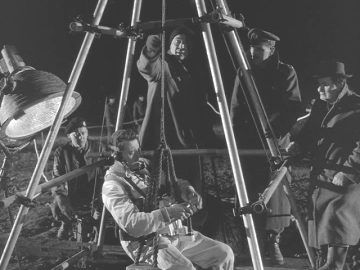 “One small snip and Dutch boy here will be painting the caves red.” |
 That's either a giant mass of mud, or Godzilla just dropped a turd. |
 Disaster struck the truck stop when the toilets backed up on chili night. |
 “Ok, shortest straw has to go get the plunger.” |
 “Niall, are you seein’ what I’m seein?” “Aye,
Conall. Tis heaven on earth… |
 “Damn these cheap radials!” |
 This is your brain on B movies. |
| Immortal
Dialog |
Keep
In Mind |
Royston puts two and two together to get ten. Hospital
director: “What is this? What are we dealing with? How
can anyone get in here when there are people outside there in the corridor
all the time?” Shadow’s comment: Attention all cars, attention all cars. Be on the look out for 10,000 gallons of oil. Suspect should be considered armed, dangerous and extremely slippery.
|
|
Major Cartwright advocates the easy way of doing things as his men proceed to bomb the fissure. Cartwright: “You know this Royston chap. Brilliant of course, I’m sure. But the trouble with some of these scientific types is that they can’t see the easy way out of anything. It’s got to be complicated if its going to work.” Shadow’s comment: Yeah, blowing someone up is the easiest way to make them see things your way. |
| Movie Trailer
|
This Film &
Me |
| |
After
spending most of the 1970’s growing up on a steady diet of old
black and white horror films from the 1950’s that were rerun on
TV, I had developed a sixth sense when it came to channel surfing. These
were the days when there were no onscreen cable guides, so knowing what
was on was not always possible. Hell, we didn’t always get TV
Guide so knowing what was on ahead of time was only made possible by
seeing a commercial for something. Thus I cultivated the ability to
spot a genre film by just looking at it. I could channel surf and after
seeing just a few seconds of a film, I knew it was an old monster flick…even
if I had never seen it before. I just knew. Such was the case
with X the Unknown. I was flicking through channels late one
night in the mid 80’s and came across the scene where Willie Harding
is stumbling through the woods in the dark, trying to sneak to the tower
and see Old Tom. I saw this and instantly knew I had to stop flicking
channels. Puns aside, there was an “X” factor to what I
was seeing that instilled in me the knowledge that this film was a monster
movie. The creepy music was certainly a clue. Sure enough, a few seconds
later the POV shot of X closing in on Willie confirmed
my suspicions and I gladly settled in to watch the remainder of the
movie. Looking at the clock I saw it was only twenty minutes past the
hour, so I figured I had the bulk of the film to go. I watched the rest
of the movie and was quite impressed. A few years later, during a time
when we did subscribe to TV Guide and I went through the week’s
movie listings in advance so as to find the date and times for movies
I wanted to see, I saw this film listed. This time around I recorded
it and over the intervening years I have watched that tape literally
dozens of times. While the film is a favorite, I didn’t obtain
the DVD until I decided what would be the first film to review under
the letter X category for this site.
|
| Rating
|
Shadow
Says |
||
|
Shadow's rating: Eight Tombstones |
The Good
|
The Bad
|
The Ugly
|
Review
Round-Up
|
Home - Review Index - Ratings - Content Icons - Links |


